
Based on a Playthrough I did of it, which you can watch for yourselves below.
Introduction & History
As most people are likely unaware of this series, I think it’d be worth giving a brief history of it before the review itself. SaGa is a franchise directed by Akitoshi Kawazu, the man who famously worked on Final Fantasy II. His philosophy was to make a JRPG in the style of a Tabletop RPG, being inspired by Dungeons & Dragons. With Final Fantasy II on release being a success in Japan, Square would allow him to branch off and make his own franchise which would become SaGa. The original three games were on Gameboy and released overseas as The Final Fantasy Legend, but with the Romancing series, many of the foundational staples of the series would be created. Romancing SaGa 2 was the cornerstone of a lot of these foundations, introducing glimmering, a unique generation mechanic, various classes, and a diversion from the standard established heroes trope that many JRPGs followed.
In 1997, a group of fans going by the name of SaGa Translations attempted to translate the game but the project went nowhere. In 2002, Gilhide released their translation, while unfinished it had completely translated the dialogue, menus, character names, technique names, town names, and the entirety of the opening prologue. This was a huge milestone and allowed the small overseas fanbase to play the game in a somewhat playable state. With the release of the 2D Remaster in 2017, any fan attempt at a translation has largely died out, as Square Enix has done the job for the fans. Another official translation would be released by Square Enix with the release of the 3D Remake “Revenge of The Seven”, which completely remade the Super Famicom original into a much more expansive and modern 3D entry with a new art style.
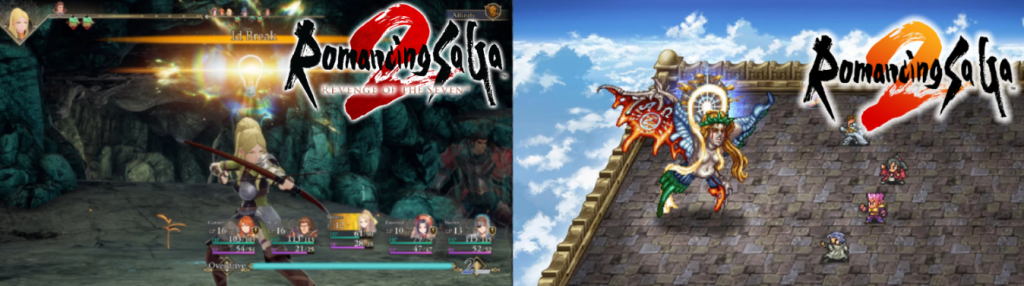
Image source: Square Enix Store, Revenge of The Seven (Left) and the Remaster (Right). The two official overseas localisations.
Section 1 – The Opening Prologue
I’ll first be taking a good look at how well translated the prologue is, which is short in itself but I still think is worth bringing up. The game opens up describing the backstory of the Seven Heroes (dubbed the “Seven Lords” in this translation) and how they heroically saved the Ancients, but in times of peace, the Ancients had forgotten their sacrifices causing the Seven Heroes to return once again with a vengeance in their new hideous forms.
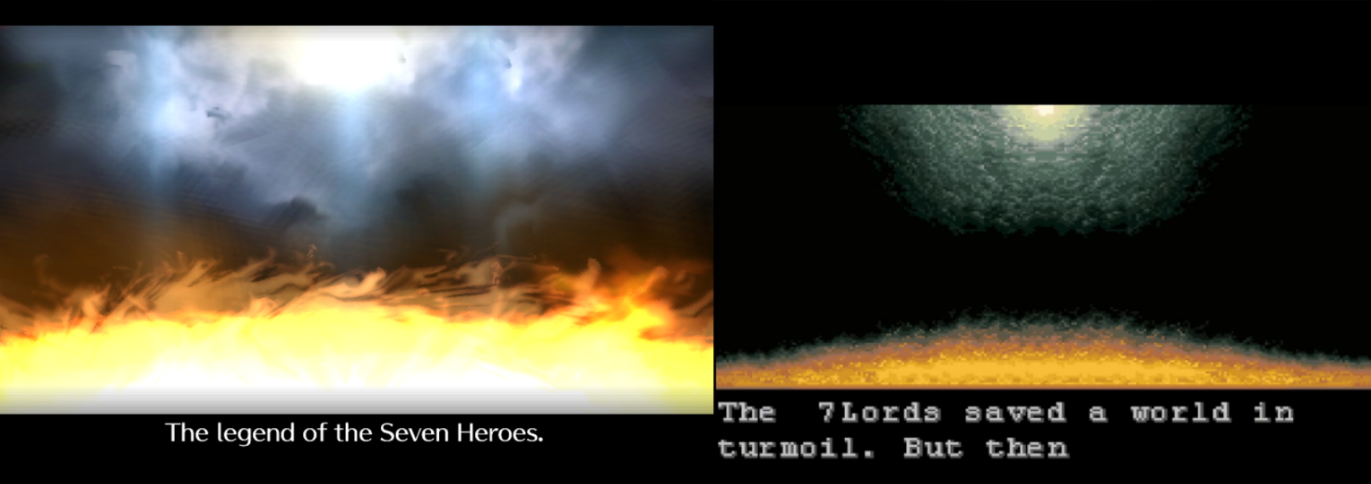
Image source: Ivor Biggun
After the text is finished, you see various overview shots of the different parts of the world, before it cuts to Somon’s last stand against the monster invasion, with its last line of defence crushed. The Seven Heroes, have returned…
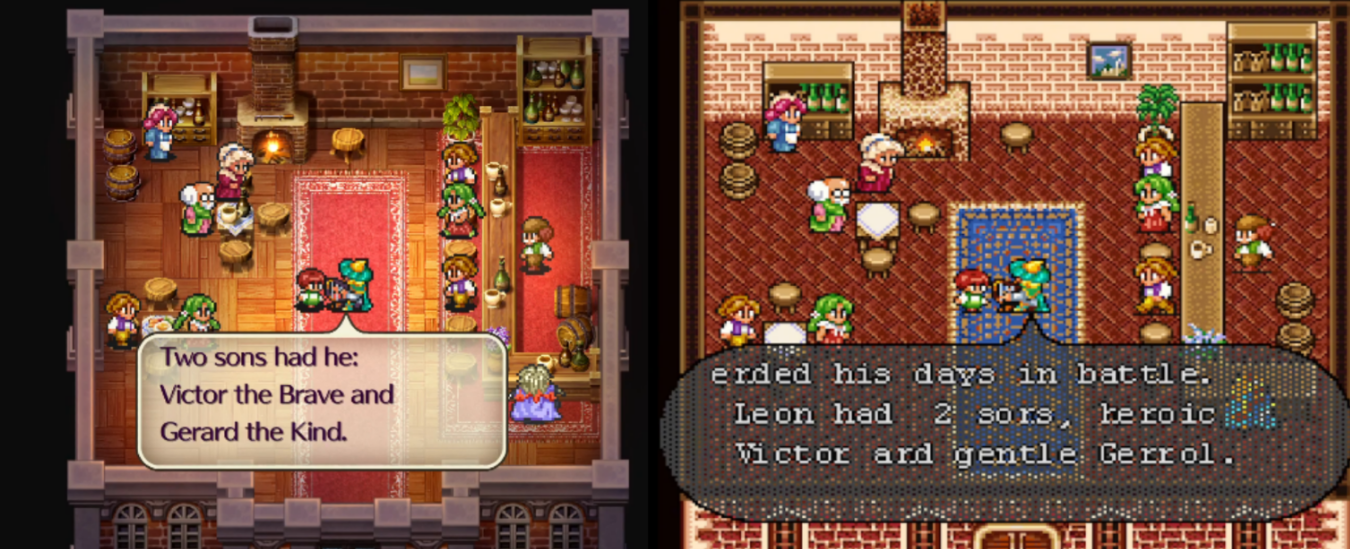
Image source: Collinity (Left), Ivor Biggun (Right)
After the cutscene ends, you make your save file and name your will be Final Emperor/Empress (who you can see at the bottom right) as the Minstrel in the pub plays the “Ode of Distant Battles”, he tells of a tale when Avalon was but small and war-torn. Emperor Leon wanted to put an end to this, and during his rule, had two sons, Victor the Heroic and Gerard the Gentle (This translation calls him Gerrol). Then the first dungeon of the game begins, and Leon gives your party the rundown on formation and the objective.
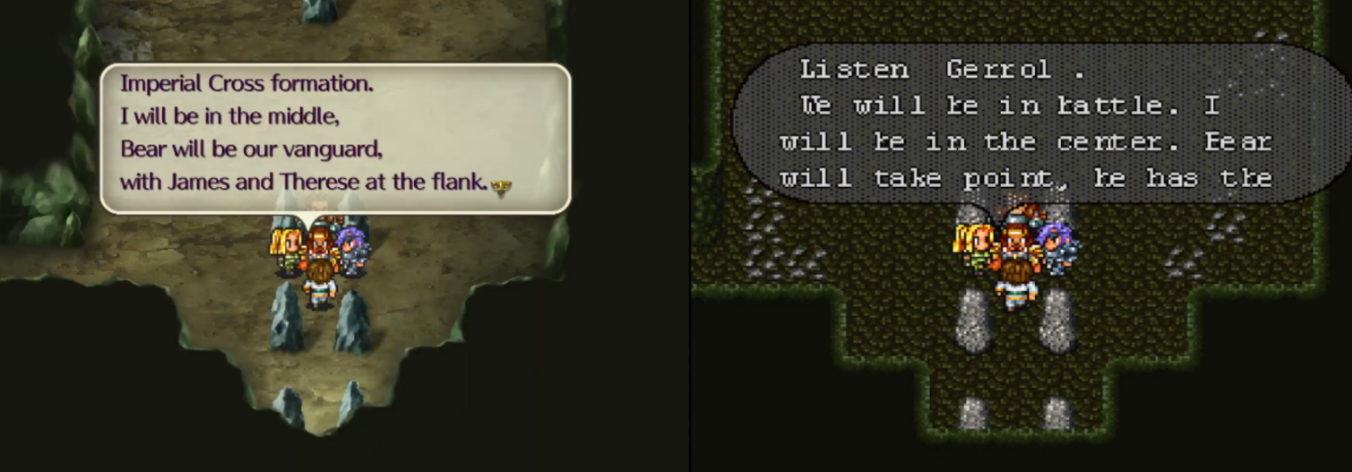
Image source: Collinity (Left), Ivor Biggun (Right)
And with this final line of dialogue, that’s the end of the prologue and where the dialogue translations come to an end. From here on out, all dialogue will just be garbage data or symbols, so it’s time to move on to the next section.
Section 2 – The Menus
Nothing is more important to any game then being able to properly navigate and understand the menus, which are all translated in full. This ranges only to your primary menu, the menu for getting skills from the Dojo, for buying items from the store, and others are untranslated (besides the names of the items/techs being archived/sold for you).
Formations are translated but the explanation of what it does when learnt at the Dojo is not. All consumable items are translated, armour and weapon descriptions are translated, the whole ten miles. Everything in relation to the menus and interface is fully in English. Character names and classes are also translated, though certain character names are also localised differently from the official Remaster.
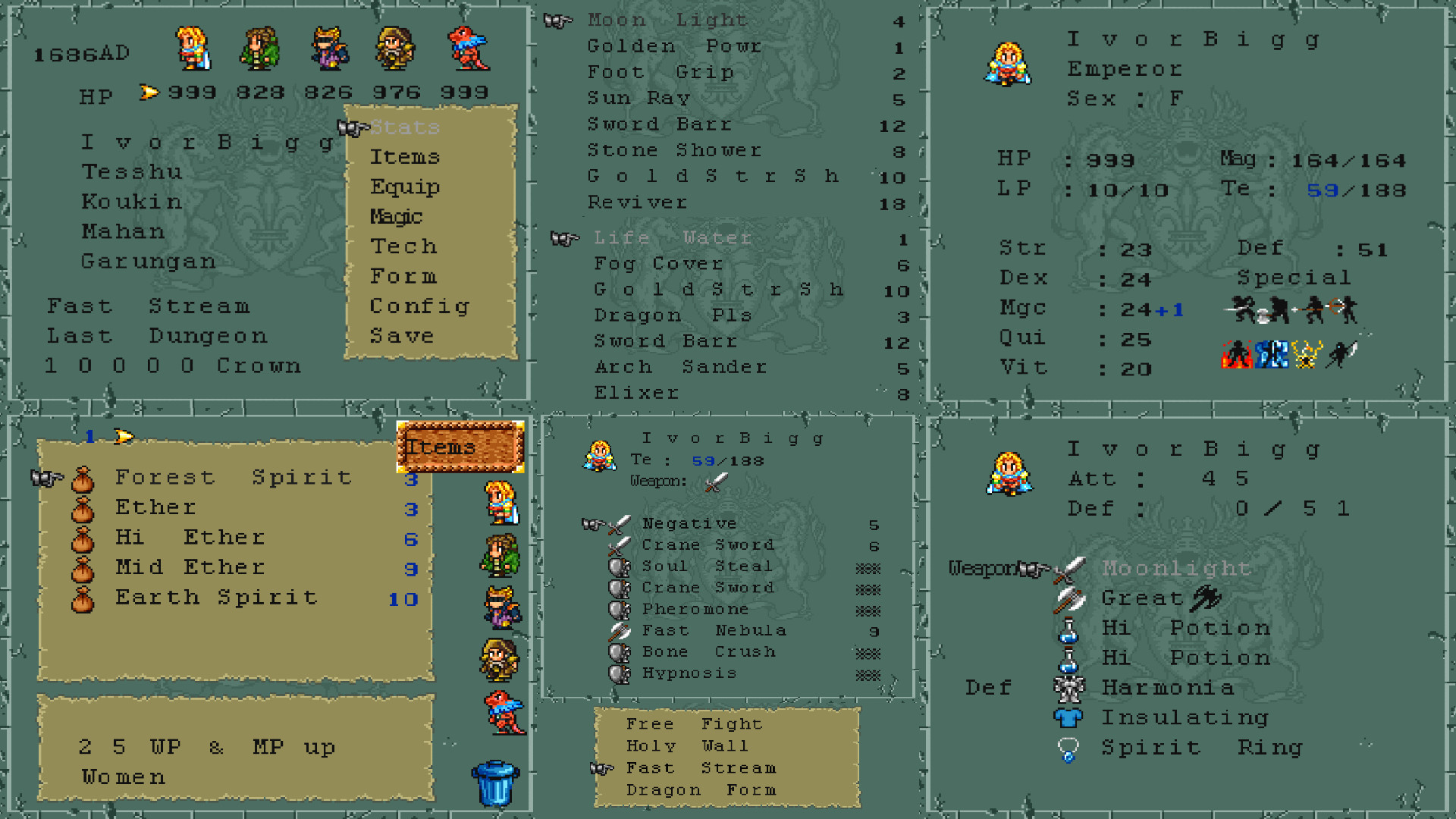
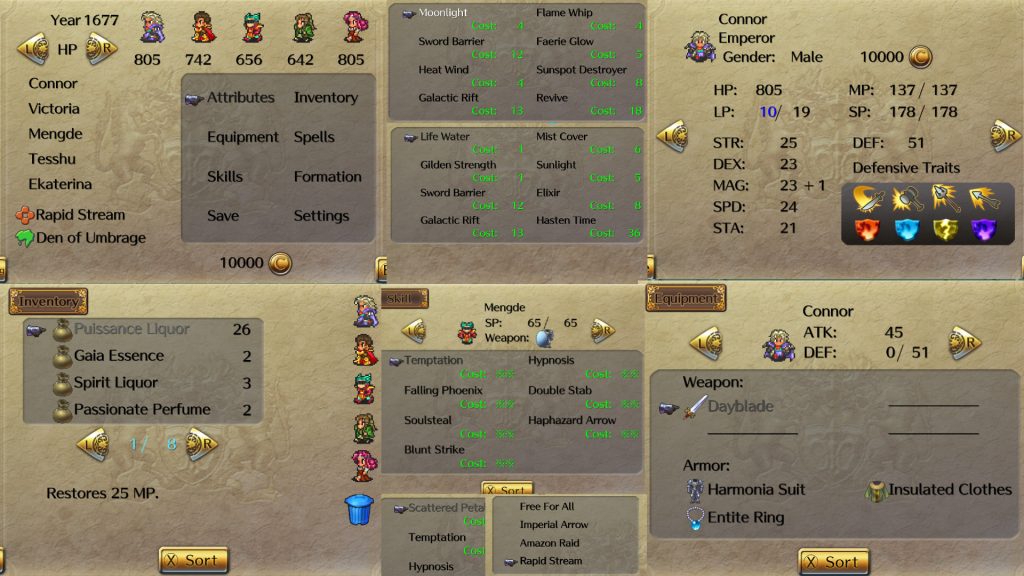
Image source: Ivor Biggun
Section 3 – Weapon, Technique & Magic names
The difference between the Remaster and the Gilhide translation is much more apparent here, whereas Gilhide focused on being as faithful to the Kanji source, the Remaster aimed at localising a lot of the names to be more western. You can see this difference with the technique “Cannon” (going by the Gilhide name) which is translated as “Guanyin” in the Remaster (Literally “Senju Kannon”, or “Thousand Armed Kannon”.) which chose the proper, literal word while Gilhide stuck to mostly translating words as they would be in Japanese, hence the difference.
[clymax’s comment: the Remaster favors the Chinese reading “Guanyin” likely as being more common over the Japanese reading “Kannon”. I would consider Gilhide’s “Cannon” as a technical mistranslation.]
| Japanese – kanji | 千手観音 |
| Japanese – furigana | せんじゅかんのん |
| Japanese – rōmaji | senju kannon |
| Gilhide | Cannon |
| Remaster | Guanyin |
| Chinese – hanzi | 千手觀音 |
| Chinese – pinyin | Qiānshǒu Guānyīn |
| Sanskrit | Avalokiteśvara, Bodhisattva of Compassion |
| FFV Central’s proposed English translation | Thousand-Armed Bodhisattva of Compassion |
Special thank you to Clymax for this sheet and his translation contributions!
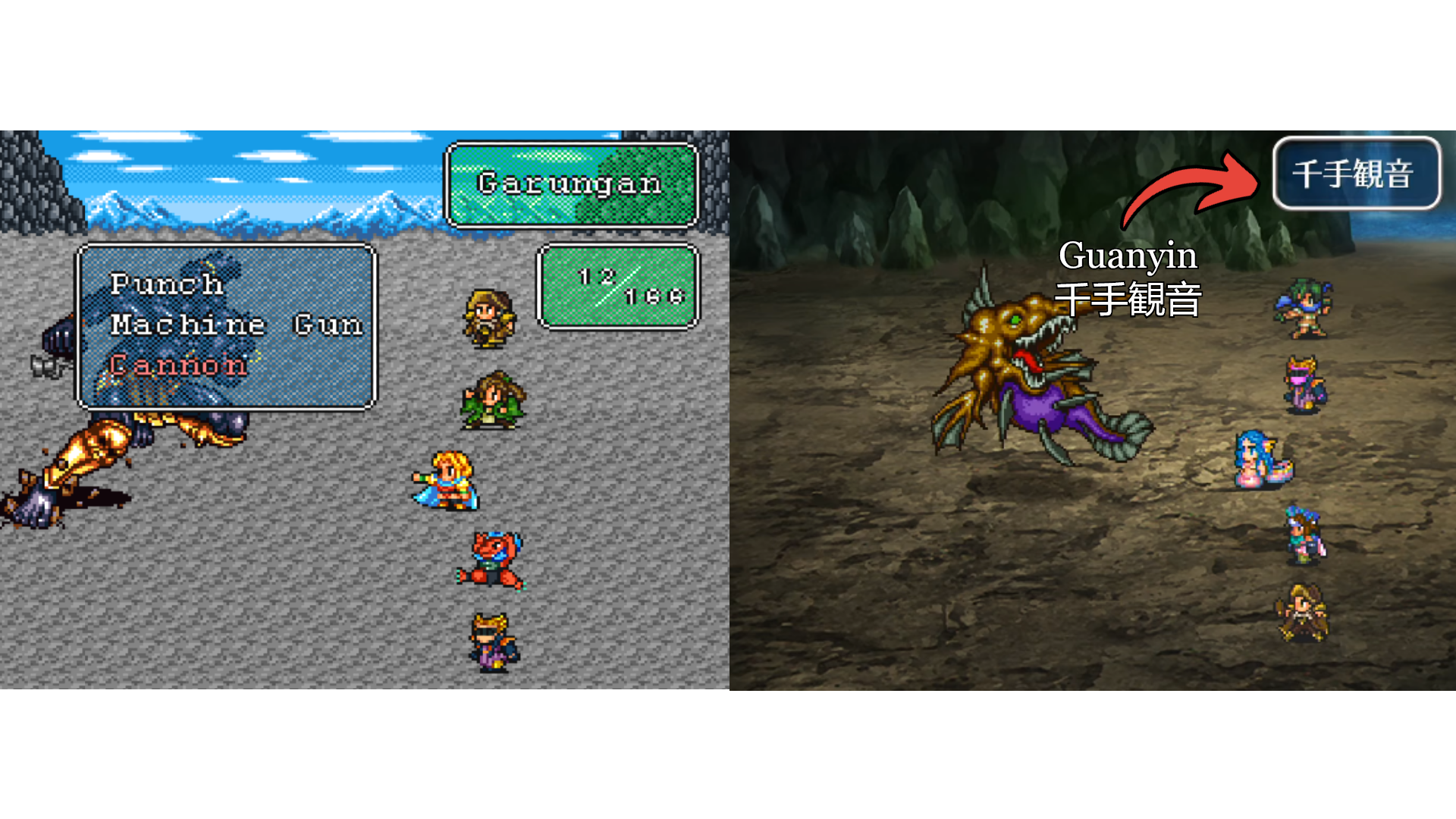
Image source (left): Ivor Biggun – Image source (right): zoffiegame6013
Section 4 – World Map and Towns
Knowing where you’re going is also just as important as being able to read and understand the crucial elements of the menu, like knowing what your weapons do. All town locations are almost a perfect match between Gilhide and the Remaster. The few differences stem from the same example I had mentioned previously, such as the translation of the mermaid town. Gilhide translated it as “Mermaid”, the literal translation of the name “Atlanticus” that the Remaster uses. Both mean the same thing. Other notable differences include Hofah (Remaster) and Forfar (Gilhide), Tefal (Remaster) and Tifal (Gilhide). Many of the much more complex names remain identical, very impressive indeed.
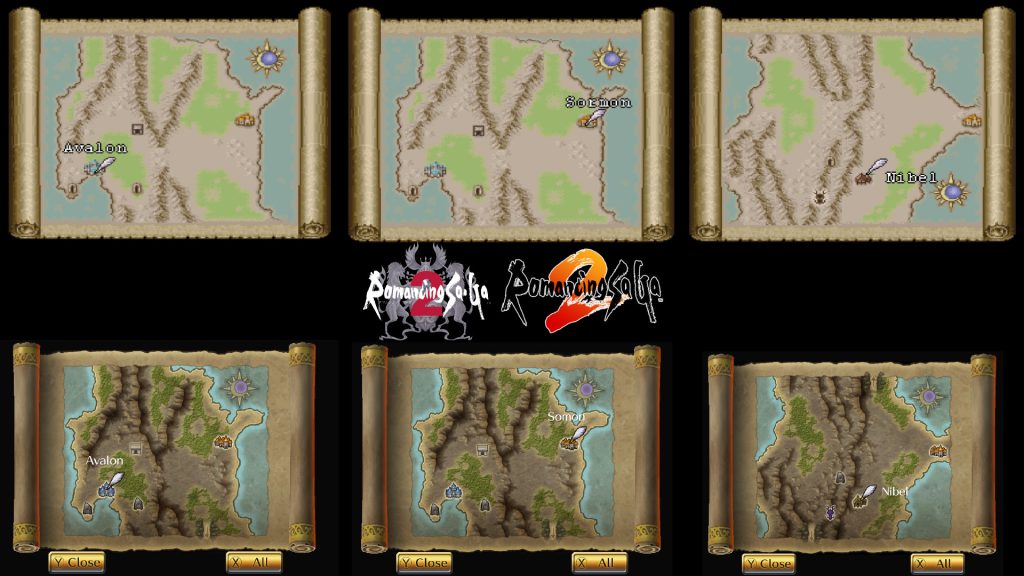
Image source: Ivor Biggun, Super Famicom 1993 (top) – Remaster 2017 (bottom)
Overall Review
After analysing mostly what we could, it’s time to finally give the rating. Comparing the two, Gilhide is shockingly near identical in accuracy to the official localisation despite being made two decades before it, although there are very evident differences between how Gilhide localised names in comparison to how Square Enix localised them, it’s much more a matter of preference over any sort of translation inaccuracy between the two. Gilhide’s translation is very good, not perfect by any means but for what it is, it tries very hard and does very well at being as faithful to the original Japanese script as it can, though it suffers in a few minor areas. My final rating is a 6/10, based only on what is actually translated (which is not counting all the garbage data dialogue). However, the high-ish rating doesn’t really mean this translation in the modern day is the most optimal way to play the game, unless you’re a thrill seeker you will be having a huge challenge with the lack of dialogue in a game that is already rather open world and directionless. The Remaster is the closest to the 2D original with a fully localised script for various languages overseas. With a walkthrough at your side however, the Super Famicom original with this translation is more than beatable even without any prior understanding of the game.
Quick Glance
| Rating | ★★★★★ ★☆☆☆☆ |
| The Good | Menus, Techniques, Weapons, Towns, and the prologue translated with mostly (with a few exceptions) great accuracy. |
| The Bad | Certain mistranslations, the rest of the game dialogue being untranslated, the ending breaking with this translation patch, some minor vague item descriptions, certain characters being incorrectly named. |
Leave a Reply